

Where Have You Been? – Blog #53
If you've noticed the blog and podcast have been missing over the past few months, I appreciate your patience. I haven't been sitting still — I've been sitting in a classroom and working on retirement from my full-time career.
I recently completed HRT 335, the Distillation, Wine and Brewing Science Certification Course offered through the James B. Beam Institute for Kentucky Spirits at the University of Kentucky. The Beam Institute — named for the legendary distilling family whose fingerprints are all over American bourbon history — is one of the most respected programs in the country for serious spirits education.
HRT 335 goes deep into the science behind how distilled spirits, wine, and beer are actually made: fermentation chemistry, distillation principles, raw ingredient selection, yeast science, and how decisions made on the production floor end up in your glass. This isn't a tasting course dressed up with lab coats. It's the real science behind why whiskey tastes like whiskey.
So why does that matter to you? Because everything I do at the Buffalo Distilling Company and the education I provide gets sharper when I understand what's happening at the molecular level — why a higher rye mash bill punches differently on the palate, why barrel entry proof matters, why two distilleries using nearly identical grain bills can produce spirits that taste nothing alike. That knowledge makes for better conversations during the tours and tasting events I lead at BDC, and it makes the Whiskey Club meetings — which we hold six times a year — more substantive than just a room full of people with glasses in their hands. If you're interested in joining us, or know someone who'd love a gift that's a little more interesting than another bottle, all of it is listed on the Buffalo Distilling Company website.
It has also opened up some interesting doors for me at Resurgence Brewing. Beer and whiskey aren't as far apart as people think — fermentation is fermentation. Understanding the brewing science side of the curriculum gives me a stronger foundation to talk intelligently about the craft beer side of the flavor spectrum and how the two worlds overlap in ways most people never consider.
Here's the honest truth about the next year or so: the education isn't done. I have a brewing course coming up in the spring, a trip to Japan with the college in May — yes, Japan, research conferences at the University of Kentucky — and additional courses still to be determined. Posts and episodes will keep coming, but I'll be upfront: they'll be less frequent while I'm in the middle of all of this. I'd rather give you something worth reading when I can than fill the blogs with filler just to post stuff.
In the Meantime — Meet the Bison Bourbon & Spirits Training Company Tasting Wheels
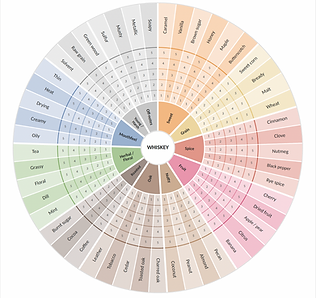
While I had some time to learn and think, I also finished something I've been building for a while: a set of tasting wheels for Bison Bourbon & Spirits Training Co. You'll see them attached to this post. There are three: one for Beer, one for Whiskey (bourbon-focused), and one for Whisky (Scotch-focused) — and yes, the spelling difference is intentional.
Tasting wheels aren't a new idea. The original Beer Flavor Wheel was developed by Morten Meilgaard and colleagues in the 1970s and was adopted by the American Society of Brewing Chemists, the Master Brewers Association of the Americas, and the European Brewery Convention. The Scotch whisky version traces back to a 1979 paper out of Pentlands Scotch Whisky Research. These are serious scientific tools with serious pedigrees.
So what makes the Bison wheels different?
Most tasting wheels are built for identification only — they give you a word and leave it at that. The Bison wheels are built for identification and communication in a single diagram. Here's how they work:
Starting from the center, each wheel organizes flavors into broad flavor classes — things like Sweet, Grain, Spice, Oak, and Fruit on the Whiskey wheel, or Aromatic/Fruity/Floral, Cereal, Phenolic, and Caramel/Roasted on the Beer wheel. Those classes are the first stop. They give you a neighborhood before you try to find the street address.
Moving outward, each class fans out into specific descriptors — Cherry, Dried Fruit, Apple/Pear, Citrus, and Banana under Fruit, for example. This two-tier approach is the standard for most wheels: start broad, then get specific.
Where the Bison wheel does something different is in that outermost ring. Built directly into each descriptor wedge is a 1-to-5 intensity scale. You're not identifying the flavor and then hunting for a separate scoring sheet. You shade the wedge from the inside out — 1 is faint, 5 is dominant — right where the descriptor lives. One diagram, one action, one place on the page.
That matters more than it sounds. Most people, when you hand them a traditional tasting wheel, can eventually find a word that fits what they're tasting. But "I get caramel" and "caramel is dominating this pour" are very different pieces of information — for the person tasting, for the person they're describing it to, and for anyone trying to compare notes across a table. The intensity scale turns a vocabulary exercise into an actual flavor profile.
One more thing about how to use these — and this part is important.
Don't use the wheel as a menu. That's the most common mistake people make with any tasting tool, and it produces the worst results. If you pick up a glass and immediately start scanning the wheel looking for something to find, you're tasting the wheel, not the whiskey.
Here's the approach that actually works: look at the wheel before you start so you know what's on it and how it's organized. Then set it down. Nose the glass. Take a sip. Sit with it for a moment and jot down whatever comes to mind in plain language — doesn't matter if it sounds silly, doesn't matter if it's "grandma's kitchen" or "that smell outside before it rains." Write it down first. Then pick up the wheel and use it to find the language that matches what you already experienced. You're not looking for answers. You're translating something you already know into words that other people can understand.
That's the difference between tasting and shopping. The wheel is a translator, not a suggestion box.
The gray wedges are worth a mention too. Those are off-notes and faults — Sulfur, Musty, Metallic, and friends. They're on the wheel because they show up in real life, and knowing what's wrong with a pour is just as valuable as knowing what's right. Being able to say "I'm getting a 3 on Diacetyl" in a Resurgence brewery sensory panel is a lot more useful than "something tastes off."
Use them at a tasting. Use them at home. Use them to argue with your friends about whether that bourbon is a 3 or a 4 on Rye Spice. Combine them with aroma kits to help you pick out things you experienced but had trouble putting into words. That's what they're for.
More content coming.
Glad to be back.
Cheers to Bold Spirits and Curious Minds!


Comments